The Lifecycle Lens:
How One Framework Transformed Nonprofit Capacity Building
The Story of NLI with Susan Kenny Stevens
Before she became a nationally recognized thought leader in nonprofit capacity-building, Susan Kenny Stevens was a clinical social worker specializing in adolescence. For 15 years, she helped young people navigate the complexities of development—a lens that would later shape how she viewed organizations.
“As a social worker, I understood developmental norms—how some adolescents were pushed to act older than they were, while others behaved much younger,” said Stevens. “That lens helped me see similar dynamics in organizations.”
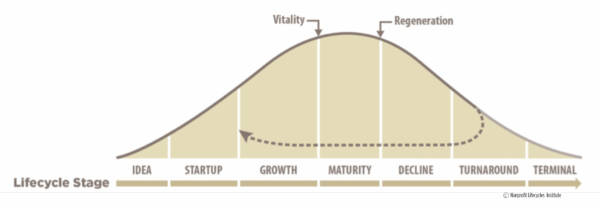
In her mid-30s, Susan launched The Stevens Group, a consulting firm that brought business principles into the nonprofit sector. But something was missing: an organizing principle. One day, she sketched a bell curve—idea, startup, growth, maturity, decline—and the Lifecycle concept was born. It was a simple but powerful framework that helped nonprofits self-diagnose their stage and strengthen their operations accordingly.
“We started consulting using this model and developed criteria to help organizations self-diagnose their stage and strengthen it accordingly.”
From Concept to Canon
By 1988, Susan had written a 7-page monograph with support from a $5,000 foundation grant. It was designed to help nonprofit executives and board members understand their organization’s stage and shore up capacity before moving forward. That early work laid the foundation for her book Nonprofit Lifecycles: Stage-based Wisdom for Nonprofit Capacity, first published in 2002 and updated in 2008.
The Stevens Group grew into a boutique firm with 20 employees and national contracts from foundations like Mellon, Warhol, and Ford. In 1998, it was acquired by CliftonLarsonAllen (CLA), where Susan continued Lifecycle and financial training for another decade. Eventually, she moved to Phoenix and began consulting with the Virginia G. Piper Charitable Trust—continuing the work that would lead to the founding of the Nonprofit Lifecycles Institute (NLI).
 A Porch, a Vision, and a Community
In January 2015, Susan invited a dozen consultants she’d trained over the years to her backyard in Phoenix. Most were escaping cold-weather cities, and the timing was perfect. They sat on her porch, dreaming about what it would look like to work together.
“I said, ‘What if I start an institute?’ Everyone was on board, and we essentially made it up right then and there.”
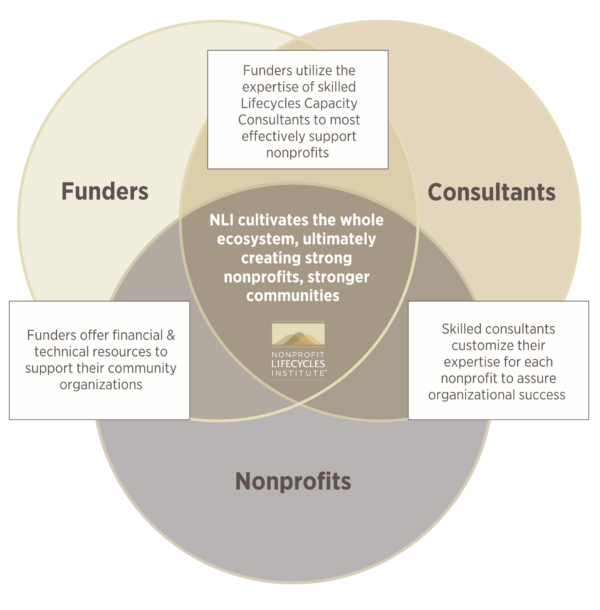
Originally envisioned as a learning community for consultants, NLI quickly expanded into something more. Susan recognized that the nonprofit sector is an ecosystem—made up of nonprofits, funders, and consultants. If any of the “table legs” (board, management, administrative systems, or business model) are weak, mission delivery suffers.
“Best practices aren’t universal—they depend on where you are in your development.”
Building Structure and Language
To formalize the work, NLI established regional hubs and hosted annual conferences. They developed workshops and courses to train consultants, nonprofit leaders, and funders on nonprofit capacity building, starting with entry-level training and advancing into deeper expertise. This gave the Institute a tangible identity and helped communicate its value to funders, nonprofits, and communities.
But perhaps the most transformative outcome of Lifecycle theory was the creation of a common language.
“The Lifecycles framework gives people a way to talk about their organization’s challenges without blame or drama.”
This language helps leaders depersonalize tough decisions, communicate clearly with funders and boards, and recognize that what they’re experiencing is normal for their stage. It’s a shortcut to clarity—and a tool for alignment across roles.
Weathering Change, Embracing Connection
By 2018, Susan brought on Jennifer Bonnett as Associate Director to help launch NLI’s membership organization. Then came the pandemic. Contracts paused, travel halted—but the Institute adapted. With Zoom and digital tools, consultants from across North America connected in new ways, expanding NLI’s reach and deepening its impact.
“Suddenly, consultants from Appalachia were in sessions with peers from Vancouver, Saskatchewan, and Southern California.”
Susan’s career has spanned over 1.8 million miles of travel, but the heart of her work remains the same: meeting people where they are. That’s the essence of Lifecycle theory—and the foundation of NLI’s mission.
 Why NLI Matters
At its core, NLI formalizes the nonprofit ecosystem and supports the often-overlooked third component: consultants. It provides validation, community, and professional development for those who guide nonprofits through change.
“This is a real career. You’re not just between jobs. You’re building something.”
The Lifecycle framework continues to resonate because it’s practical, adaptable, and deeply human. It’s not about one-size-fits-all solutions—it’s about understanding where you are, what you need, and how to move forward with clarity.
“It’s a kind of holy trinity: nonprofits, funders, and consultants. Each leg supports the others. And when all three are strong, the whole ecosystem thrives.”
Want to learn more about nonprofit capacity building with NLI? Visit our Lifecycles page for an overview and starting point.