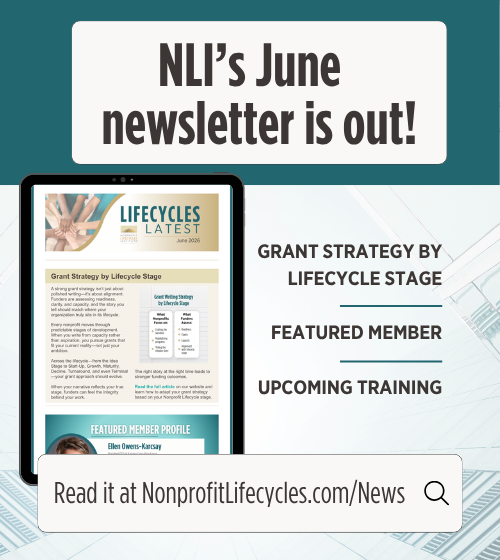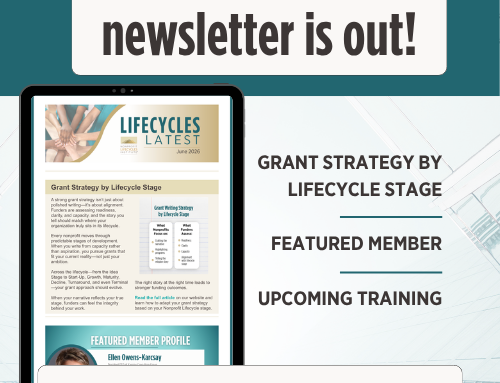
Grant Strategy by Lifecycle Stage
Learn how to tell the right story at the right time for greater funding success.
Every organization moves through predictable stages of development, and your grant strategy should move with you. Funders are assessing more than writing quality—they are assessing readiness, clarity, and capacity. The Nonprofit Lifecycles Institute’s Lifecycle stage model helps you understand where your organization truly sits, allowing you to write from capacity rather than aspiration. When you know your stage, you can pursue grants that match your readiness—not just your ambition.
The Organizational Lifecycle and Grant Strategy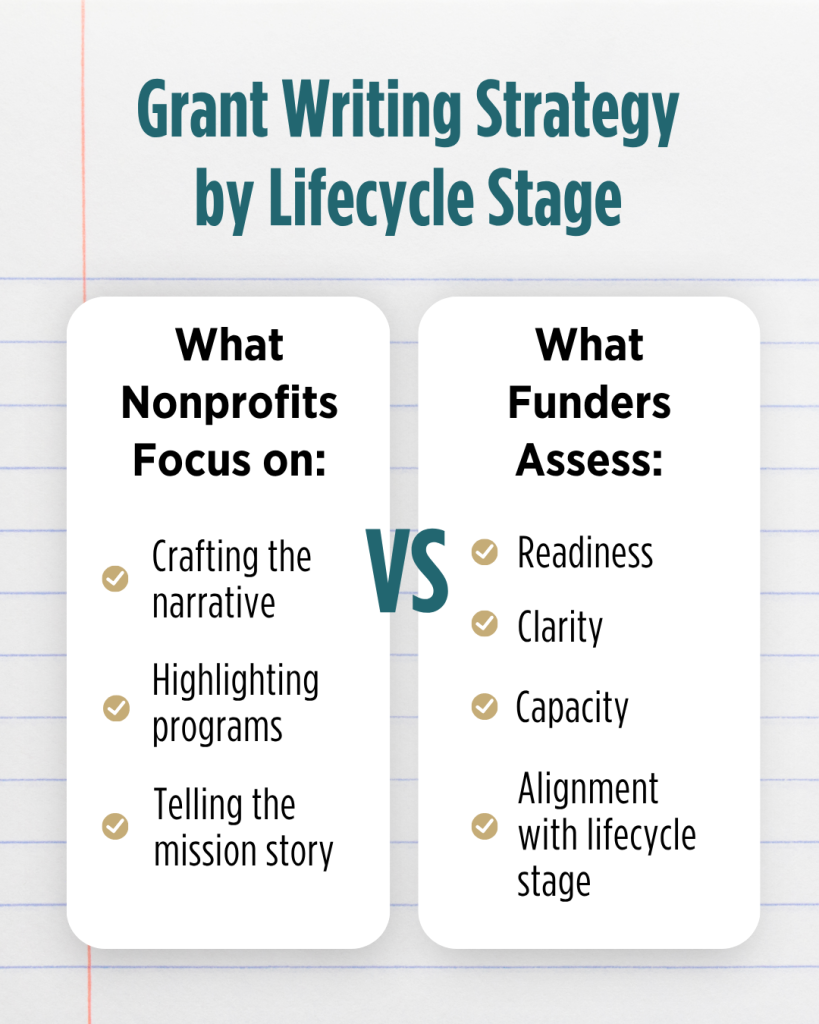
Idea Stage: Build Relationships and Clarify the Vision
At the idea stage, the organization is still forming its identity. The priority is not chasing large grants—it’s building relationships, refining the mission, and gaining clarity about the problem you want to solve.
Fiscal sponsorship can be a strategic move, building funder confidence while allowing you to test and refine your concept.
Start‑Up Stage: Tell a Passionate, Learning‑Oriented Story
Start‑ups thrive on passion, experimentation, and early wins. Funders at this stage want to see:
- A compelling origin story
- A learning mindset
- Evidence of early traction
This is the moment to pursue early‑stage capacity grants—funding that helps you pilot programs, build some basic systems, hire versatile staff.
The priority is not chasing large grants—it’s building relationships, refining the mission, and gaining clarity about the problem you want to solve.
Growth Stage: Scale Systems and Prove Success
Growth brings momentum—and complexity. Grants at this stage should help you:
- Strengthen and scale infrastructure
- Expand programs
- Demonstrate measurable outcomes

Funders expect growth-stage organizations to demonstrate that they have established a promising model and are building the systems, staffing, outcomes, and infrastructure needed to expand their impact in a realistic and sustainable way.
Maturity Stage: Deepen Strategy and Demonstrate Long‑Term Impact
Mature organizations have established programs and strong track records. Grants here should support:
- Strategic deepening of programs
- Innovation within proven models
- Long‑term impact backed by strong data
Funders look for organizations that know who they are, what works, and how they will continue delivering results.
Decline Stage: Refocus and Rebuild
Decline doesn’t mean failure—it means recalibration. Grants at this stage can help you:
- Reassess your mission
- Address immediate operational needs
- Reignite relevance
The goal is to stabilize and reposition the organization for its next stage.
Funders appreciate honesty about challenges when paired with a credible plan.
Turnaround Stage: Restore Integrity and Stabilize Operations
Turnaround requires transparency and humility. Funders appreciate honesty about challenges when paired with a credible plan. Grants should focus on:
- Stabilizing operations
- Rebuilding trust
- Restoring organizational integrity
This is a moment for clear-eyed leadership and disciplined execution.
Terminal Stage: Close with Dignity and Care
Sometimes the right decision is to close. Grants can support:
- Responsible wind‑down
- Transitioning clients and programs
- Preserving institutional knowledge
A thoughtful closure is a form of stewardship and a moment to honor and celebrate the years of service, impact, and community care the organization has contributed.
 Final Thought
A winning grant strategy isn’t about chasing money—it is about telling the right story at the right time, grounded in who your organization truly is. When your narrative aligns with your lifecycle stage, your mission, and your capacity, funders can feel the integrity behind your work.