Nonprofit Capacity Building:
What is it and Why is it Important?
Nonprofit Capacity Building: Strengthening Nonprofits at Every Stage of the Lifecycle
At Nonprofit Lifecycles Institute, we know that passion alone does not sustain a nonprofit—capacity does. Effective, resilient organizations aren’t born; they’re built through intentional investments in leadership, systems, and infrastructure aligned with their current Lifecycle stage of development. This is the essence of nonprofit capacity building.
What Do We Mean by Capacity?
Capacity is the organization’s ability to deliver on its mission consistently, effectively, and sustainably. But it’s not a one-size-fits-all concept. Just as people grow and evolve, so do organizations. Each stage of the Nonprofit Lifecycle—from Idea to Terminal—comes with its own strengths, challenges, and capacity needs.
Capacity building, therefore, is about building the right strengths at the right time. It is the strategic work of shoring up key foundational areas—governance, business model, management, administrative systems—so that the organization’s mission is not just aspirational, but achievable.
Why Nonprofit Capacity Building Matters
When nonprofits invest in their own capacity, they’re reinforcing the very structure that allows their mission and programs to thrive. It’s about more than just doing good work—it’s about doing it well, consistently, and for the long haul.
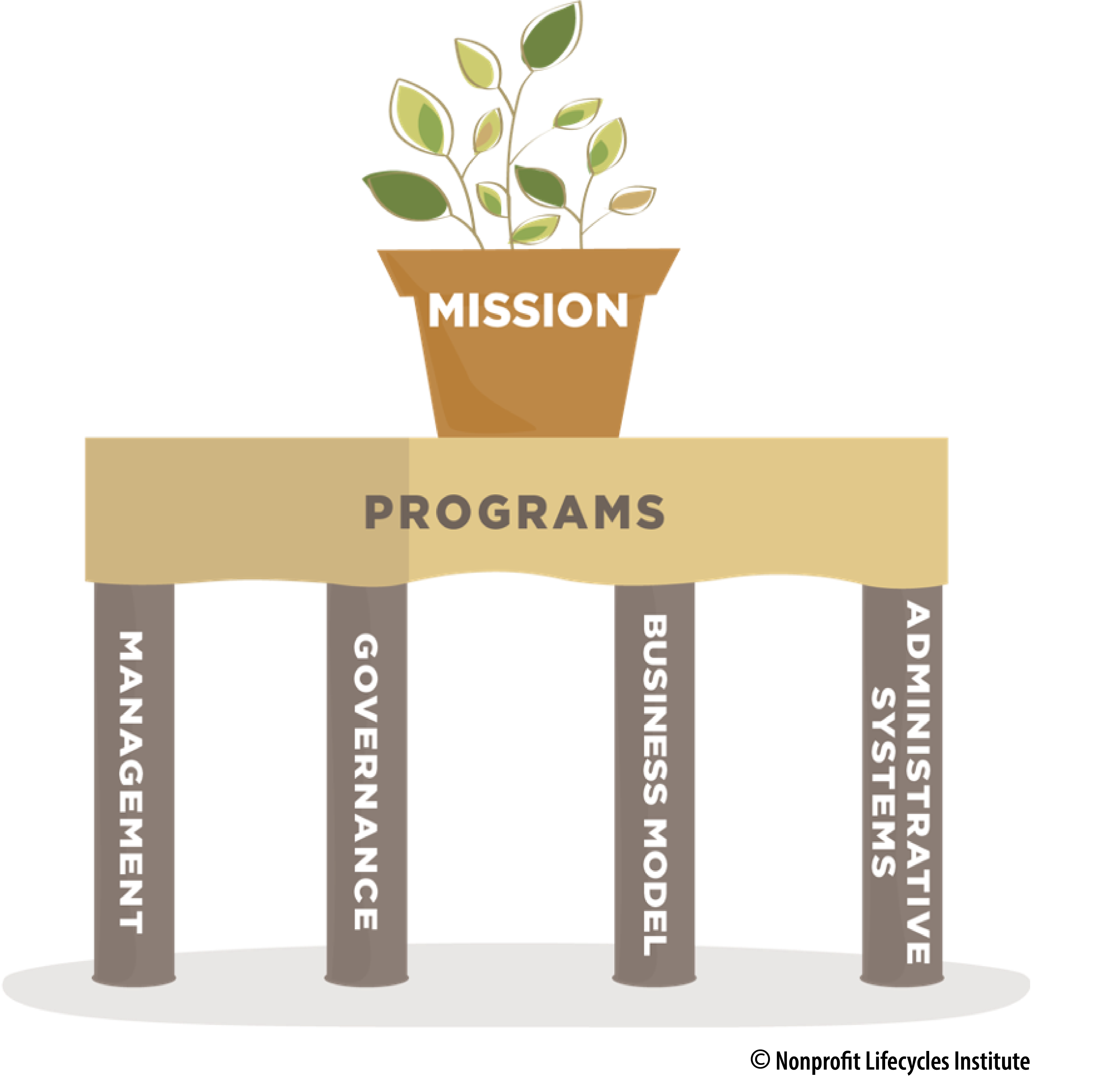
Too often, organizations rush to place new programs on the tabletop—or trim down what they see as “overhead”—without realizing the table legs beneath may be wobbly or under-built. When the table legs—governance, management, business model, and administrative systems—are misaligned or weak, even the most inspiring mission (the vase) and dynamic programs (the tabletop) risk toppling.
Capacity building is the intentional strengthening of those hidden but essential supports. It ensures your organization has the alignment, strength, and flexibility to hold up your programs—and your mission—now and into the future.
Here’s why capacity building matters:
- Effectiveness: A well-balanced table supports programs that are impactful and measurable.
- Sustainability: Solid financial systems and diverse revenue are like sturdy legs—preventing collapse under stress.
- Adaptability: Strong legs allow your organization to pivot, scale, or reset without destabilizing the whole structure.
- Leadership Continuity: Boards and staff pipelines are part of the legwork—critical to standing tall through transitions.
- Credibility: Funders and partners can see when the table is stable, and they’re more likely to invest in what’s well-built.
Whether you’re in Start-up, Growth, Maturity, or navigating a Turnaround, capacity building is how you reinforce the foundation beneath your mission.
Lifecycle-Informed Investment
What makes our approach different is that we begin by assessing an organization’s Lifecycle stage. An organization in the Start-up stage does not need the same type of support as one in Maturity or Turnaround. When you align your investments—time, funding, training—with your current stage, capacity building becomes strategic and effective, not overwhelming.
Examples you may find for organizations at different Lifecycles stages include:
- In Start-up, it’s about clarifying purpose, creating programming to meet that purpose, founding a board, and even early fundraising efforts.
- In Growth or Maturity, you may find efforts to systemize operations, succession planning, and impact evaluation.
- In Decline or Turnaround, it may involve restructuring leadership, renewing board engagement, and revisiting core strategy.
There’s no shame in any stage. What matters is recognizing where you are—and what you need next.
Nonprofit Capacity Building is a Shared Responsibility
Funders, consultants, and nonprofit leaders each have a role to play. Funders provide the investment and support necessary to improve a nonprofit’s ability to accomplish its mission. Consultants bring valuable expertise and specialized knowledge to help nonprofits navigate complex challenges and achieve their goals effectively. Boards and executives can create space to reflect, refocus, and rebuild. Here at Nonprofit Lifecycles Institute, we bring these groups together by cultivating a collaborative ecosystem grounded in shared language, mutual learning, and strategic capacity building.
Final Thought
Nonprofit capacity building is not about fixing what’s broken—it’s about investing in what’s possible. When nonprofits align their efforts with their Lifecycle stage, they don’t just grow. They thrive.
At Nonprofit Lifecycles Institute, we’re here to help organizations, consultants, and funders use the Lifecycle framework to build capacity that lasts. Let’s grow wisely, together.